Posts: 1,398
Threads: 22
Joined: Jun 2022
Good question.... I'm hoping their tracking doesn't degrade, and maybe they will even run better.
Never had much of a problem with the tracks flat with either locos or rolling stock - maybe some issues with keeping trailers on 89' TOFC occasionally. Believe me, if I encounter more problems after the superelevation is finished, that M420 is going up for sale and I'll return the curves to flat and level. A beautiful locomotive model is not worth extreme pain and hardship.
Posts: 1,398
Threads: 22
Joined: Jun 2022
Update on the superelevation project. One out of the 4 track sections has been glued in and working flawlessly (at least with the M420 at all speeds, orientations and directions). However, that is the only one of the 4 pieces that is a continuous superelevation. After I glued down piece number 1 adjacent, the loco derailed in a couple of places, especially in the transition between a 2mm superelevation and back to flat (unsuperelevated track) where the loco comes out of the curve. I determined I needed a more gradual transition and that meant lifting that piece out again. HOWEVER, when I'd glued it down I didn't have my standard silicone sealant handy and I resorted to Marine Goop. BAD IDEA! That stuff dries hard and is super-adherent. The track did not survive and I had to redo some of the roadbed and install a brand new piece of Code 83 flex track. The roadbed fix also created humps and bumps that needed to be sanded smooth and shims added in several areas, but I think I now (after 4 days of trial and ERROR) have that piece ready to be glued back down to the roadbed (not with Marine Goop!) since the loco now runs all the way through the transition and through the aforementioned good section of superelevated track. For those wondering, these are roughly 26"-radius curves - the tightest on my layout, but they are a far cry from the minimum radius that Rapido quotes - 18".
If after gluing this piece down and verifying continued good running of the loco, I'll then deal with the other half of the curve (the other two sections of flex track) which also contains a reverse curve before going into the tunnel, which means that I'll be doing 3 more transitions between flat and 2 mm superelevated track. Do I still love the deal I got on this locomotive? Sure, but there's a lot more buyer's remorse than when it first emerged from the box. Maybe I'm learning something beneficial if I ever build a new layout.
Posts: 1,389
Threads: 151
Joined: Jan 2009
I live by the rule measure twice cut once any track re aliment I do is not set solid till I'm happy with the set, but it looks like you set track directly on the foam I use a cork tape used for making radiator gaskets on large one's like trucks or equipment a fifty foot roll is about 35 or 40 dollars or t use to be. Also for track glue I just use house paint sets up solid.
Jim
Posts: 1,398
Threads: 22
Joined: Jun 2022
This is why I like this site. All kinds of great tips!
Posts: 1,398
Threads: 22
Joined: Jun 2022
Superelevation update for today. I'm pleased to report that 3 of the 4 sections of superelevated track have been tested for use with the Rapido M420.... and all passed with (eventually) flying colors - some tweaking was necessary, especially around track joints. I just finished running the 3 continuous sections at sampled speed ranges from low to max speed, forward and reverse in both loco orientations without derailing. I'm feeling pretty good about the future, and the light at the end of the tunnel is within sight (if I squint).
I did send Rapido an email message late yesterday - text of it is below. Not sure it will engender much good will from Rapido, and I think there's only a small chance that my message results in a change in design or some future words in a manual, but I had to try:
"Recently procured one of your products. This unit (an M420W #33014 "HO Scale MLW M420 (MR-20b) Canadian National #3545 (Stripes Scheme)) had been derailing at a very annoying frequency in a set of winding 26"-radius curves with a continuous grade of about 2% since I acquired it in December. I would have liked to have bigger curves and less grade on my layout, but I'm short on available space and have made due since 2006.
I have about 16 other diesel locomotives (4 and 6 axle) from a variety of manufacturers (Athearn, Atlas, Stewart, Bachmann, etc.). Your model was my first Rapido. No derailment issues for any of my other locomotives. Aside from the derailment issue, I LOVE your M420 (I think the details, weight and power are fantastic) and I want to keep it, and I want to run it. Therefore, I did a deep dive into these curves and the differences between this Rapido model and my other locomotives. Here are my findings (in no particular order):
1) The primary source of derailment for the M420 is wheel lift on one of the four axles as the loco negotiates these graded turns. Flange on the outside wheel (this can be either the front or rear wheelset of either truck) climbs over the rail or the inside wheel falls off the rail while turning and climbing or turning and descending the grade.
2) The main difference between the Rapido trucks and anything else I have is the relative stiffness of the trucks in the roll and pitch axes. They are less nimble (more rigid) and allow less potential movement in roll and pitch axes than anything else I have. I do not see any method to adjust this stiffness from my end - it's built into your design.
The aforementioned section of track has a lot of scenery installed and the track had been ballasted. Nevertheless, since I am bound and determined to run this model on my layout, I explored superelevating the outside rail in this set of turns by 2mm. Having the weight of the locomotive push the inside flanges into the rail (in my case) was the secret sauce to success. However, transitioning back to the flat tracks beyond the curves was also troublesome as the front and rear trucks end up rolling over constantly changing track profiles. What I found was a gradual superelevation change (at least 2 locomotive lengths) can work. Believe me, this exploration has been rough and I've spent the better part of this month on a 12-ft section of track and my new locomotive.
So, why did I write this? 1) I love your manual, but your tough-and-cheek comment about "no problem negotiating 18-in curves", and avoiding modeling theme park operations is a bit too flippant. Based on a couple of forum entries, it appears that I am not the only one to encounter similar problems negotiating much wider curves that 18-inch radii. 2) Since it worked for me, suggesting superelevating track may be something that is suggested in the manual if there are derailment issues in curves, or maybe you could look into this issue and potential fixes to layouts that will allow operation without derailment. 3) I'd suggest that retooling future models or offering a retro kit to allow for more pitch and roll of the trucks should be undertaken by Rapido.
Again, I care enough about keeping your loco on my layout so important that I trashed a good bit of scenery and spent a lot of frustrating days figuring all of this stuff out. I'm floored by the level of detail and the great operation (at least on straight track). I hope you can keep producing unique models like this one and I applaud your attitude toward our hobby."
Posts: 1,398
Threads: 22
Joined: Jun 2022
I didn't get a reply back from Rapido, but in the meantime, I joined the user's group where Charlie found the "M420 Derail" messages - canmodeltrains and started looking at all of the messages regarding the M420. There were two of those that perked my ears up - one in which someone had their retailer send his model back to Rapido and they made changes to his worm gear clips that both hold the worm gear in place and rest the trucks in the chassis. The clips were altered to allow more side to side movement of the trucks...
In the second, one of the respondents was describing how to do this yourself. Sent him a message and he sent me a guide from Rapido on how to alter the clips about an hour after I sent him a message. I will try making that change tomorrow night. Too bad I didn't find this a month ago. Se la vie, Eh?
Posts: 11,038
Threads: 250
Joined: Dec 2008
(01-21-2026, 08:00 PM)TMo Wrote: I didn't get a reply back from Rapido, but in the meantime, I joined the user's group where Charlie found the "M420 Derail" messages - canmodeltrains and started looking at all of the messages regarding the M420. There were two of those that perked my ears up - one in which someone had their retailer send his model back to Rapido and they made changes to his worm gear clips that both hold the worm gear in place and rest the trucks in the chassis. The clips were altered to allow more side to side movement of the trucks...
In the second, one of the respondents was describing how to do this yourself. Sent him a message and he sent me a guide from Rapido on how to alter the clips about an hour after I sent him a message. I will try making that change tomorrow night. Too bad I didn't find this a month ago. Se la vie, Eh?
Todd,
I was trying to figure how you could get some more freeplay in those trucks but that is so simple it never crossed my mind. Those clips are common on many locomotives and it happens I have a couple that this could help with their performance. Now I have to remember which ones they are. Thanks for the update. I hope Rapido is making this modification to all that are in production.
Charlie
Posts: 1,398
Threads: 22
Joined: Jun 2022
Charlie,
You would hope. However, after completing the modification (the biggest pain is getting to the two clips which are located under the cab (exterior and interior of the cab need to be removed) and under the circuit board and weight on the long hood), the amount of material you file off of the round section of the clip where it interfaces with the frame is (their recommendation ) 0.5 to 1.0 mm of plastic. That's not much to file off, but probably enough material to force tightening the tolerance of that part in production.
Like you said, apparently this is a pretty common design. I think this potential mod ought to be cited in their manual, or they mention that buyers should be able to ship the locomotive back for them to do the mod free of charge. At least I learned something along the way!
Posts: 1,398
Threads: 22
Joined: Jun 2022
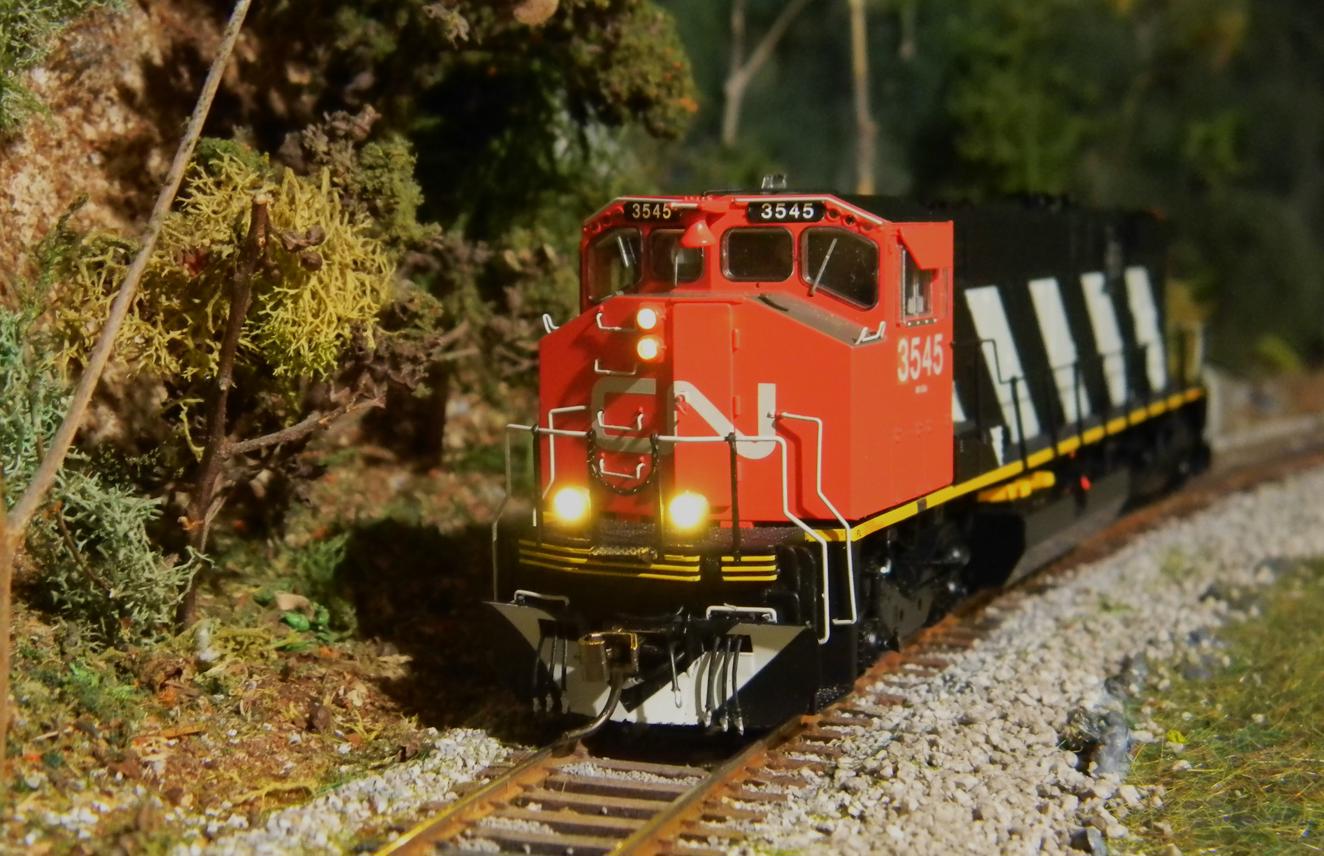
The light at the end of the tunnel is fully electrified. I've been running the M420 around the full viewing level without derailment one - forward, reverse, switching the orientation and running forward and reverse again from minimum to maximum speed. The final (4th) section of flextrack has been connected and will be glued down tonight, but the M420's been flawless running through the set of curves over all 4 track sections. Prior to redoing the scenery in Mud Run Curve I'll be running trains to make sure the superelevations haven't induced a set of new problems.
Still no message from Rapido. I have mixed feelings. I'm glad that I was provided a set of detailed instructions (with pictures) that were authored by Rapido (and supplied by another owner), but it seems to me that same information ought to be directly available on their website if it's an issue that even a small number of customers would be expected to encounter. Instead (thanks to the alertness and of Charlie to find someone with the same problem), I had to do my own legwork to find the solution. And then there's tearing up track (never good) and damaging scenery doing so (never good). Nonetheless, it's great to see my new beautiful locomotive flying around my viewing level at top speed. I even figured out how to engage the track inspection lights on the front railings which are quite cool.
Posts: 11,038
Threads: 250
Joined: Dec 2008
Todd, I am glad things are coming together. I was thinking the least Rapido could do is provide properly modified clips for their customers much like Proto did when they got bad gears for their locomotives. I am really disappointed with customer satisfaction for all of the model makers. BLI had a run of bad gears on some of the locomotives and they replaced them for free for a long time but after a time they quit supplying them even if you offered to buy them. The last ones I replaced were over 40 bucks from NWSL which is pretty pricy for a gear the size of a nickel. These manufacturers seem to forget that most of us keep our models for a life time. I have Blue Box locomotives running on my layout that are at least 55 years old and run well with DCC.
Charlie
Posts: 1,398
Threads: 22
Joined: Jun 2022
I'm sorry to report that from my foxhole, the quality of customer service has steadily eroded in virtually every industry, Charlie. I guess in the hobby world you would hope that more of the people involved might be hobbyists themselves, but things could certainly be better. Based on the manual that came with the locomotive, at least the guy who wrote it seemed to take great delight in writing it.
No great debacles in running trains over the superelevated Mud Run Curve, so I'm going to start resetting some of the damaged scenery mauled by my elbows and arms during the track removal, installation and tweaking. I might even reduce the number of trees between the river and the track there to allow more viewing of trains (and taking of pictures) on that curve!
Posts: 1,398
Threads: 22
Joined: Jun 2022
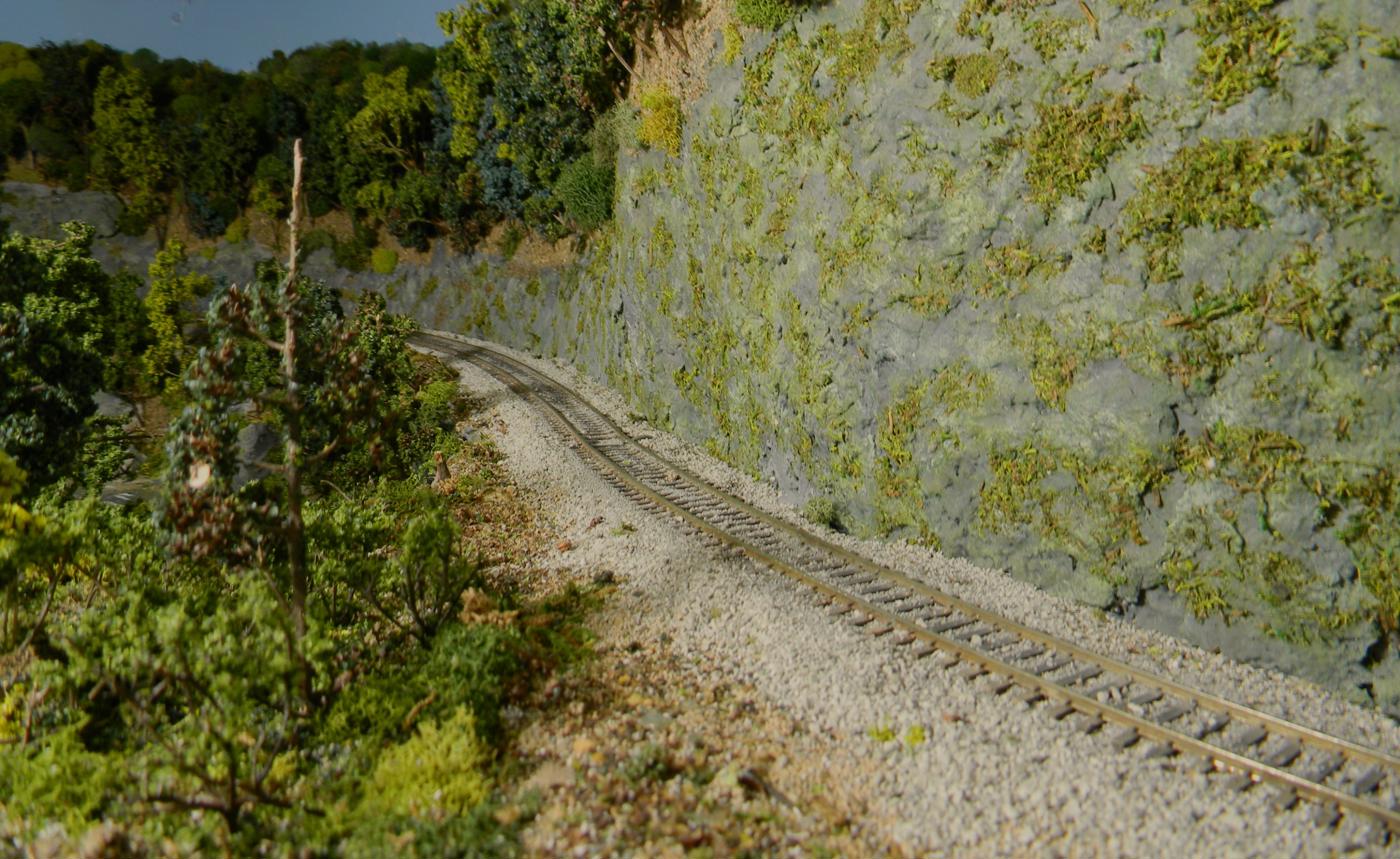
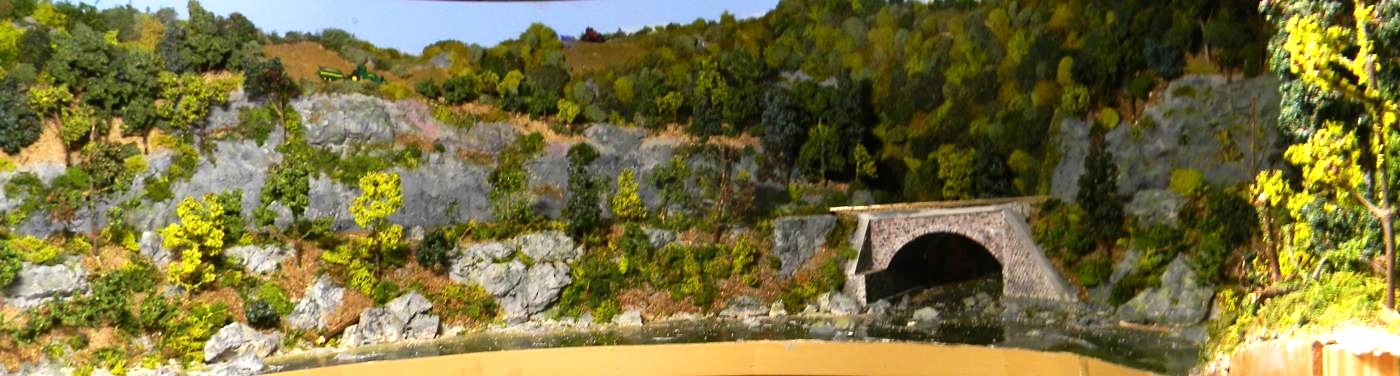
Painting of damaged vertical stone faces has been finished and the rough ballast application is also complete. I'm hoping to get to the removal of stray ballast and start gluing her down in the next couple of evenings. As you might notice in the photo below, it looks like a tornado has shorn off the top foliage of a bunch of trees on the left. No tornado - elbows, arms, tools, track sections have done quite a bit of damage to the tallest of the trees which will need to either be replaced or removed and renovated.
Posts: 6,840
Threads: 1,141
Joined: Nov 2008
Looks Great!!!
I hate that part! Not only do you have to fix the parts you needed to repair, but you have to fix everything you broke while doing the repair. 
Posts: 1,398
Threads: 22
Joined: Jun 2022
You're right, Mikey. My only consolation is that I mostly tried to be careful with the track removal and reapplication, so it's not a complete restoration job. Glued down my ballast last night all the way around the curve and I've been running trains tonight. Had to tweak one section of track super-el, near the middle of the main curve, but looking good at the moment. I'm kinda liking the sparser forested foreground - let's you get more views of trains, so I may do some wholesale tree movements or some eradications in this restoration.
Posts: 1,398
Threads: 22
Joined: Jun 2022
Information becomes powerful....
Ran my Intermountain chassis (with a blue box SD40-2 shell in Conrail blue). It would also derail running around the superelevated Mud Run Curve even though I wasn't having problems. Upon inspection I determined that the truck roll was pretty stiff. Popped it open and filed down the truck clips a bit and she's running well around Mud Run.
|