

12-09-2010, 07:00 PM
Today, I'm doing some serious re-thinking about one of the industries on my proposed ISL - The Trinidad Benham facility specifically. http://www.the-gauge.net/forum/viewtopic...=24&t=3731 Although I was thrilled to discover this industry as a potential destination for my covered hopper fleet - I'm not so sure now if I want such a "space eating" type industry on the layout.
By "space eating" I mean industries that require track lengths that are double the car capacity of the facility; grain elevators; coal tipples and similar industries that must move their cars to load/unload them, for example. Although I knew this when I found the industry; Trinidad Benham is a "space eater". If my model of this facility is designed to spot 3 covered hoppers, then the track must clear at minimum 5 car lengths (one in the shed unloading - and room for two more on either side) - not very efficient for an ISL. I really like this facility - it's large - not something you see every day and fits in to the modern industrial theme. But is it a good choice for an ISL?
The Temple-Inland industry is what I call an "operational" industry, meaning that several cars can spot on the industry track at specific locations and none of them must be moved for loading/unloading. I love large facilities that actually look like they would be rail served, but not if the number of cars that spot does not use most or all of the track space. IMHO, that's almost as bad as having a single car spotted at a structure that's only slightly larger than the car or a large structure that only has one car spot (they do exist).
So at this point, I'm wondering if I should replace Trinidad Benham with another "operational" type industry that would spot box cars (I love box cars!) or leave well enough alone? BUT if I do replace it with something, then what to do with my rather large fleet of trough hatch/gravity discharge covered hoppers?
I've seen many examples over the years of facilities where these gravity discharge type covered hoppers are spotted and don't require the cars to be moved because the shipper/consignee uses portable conveyors that can be moved as required. Jack Hill has one such example on his web site: http://oscalewcor.blogspot.com/2010/09/s...-spur.html.
I don't want to turn my plan (or any plan I conceive) in to a "track in every corner" type layout, but I could perhaps add another short spur to the plan where I could spot 2 or 3 covered hoppers without having to use excess track space. Question is what sort of facility would be on this spur?
I suppose if worse comes to worse I could simply spot them on the trans-load (team track) and use portable conveyors to load/unload some commodity. And while I'm thinking about it, does any one make HO scale portable conveyors like what is shown in this photo or would this be a potential scratch building project?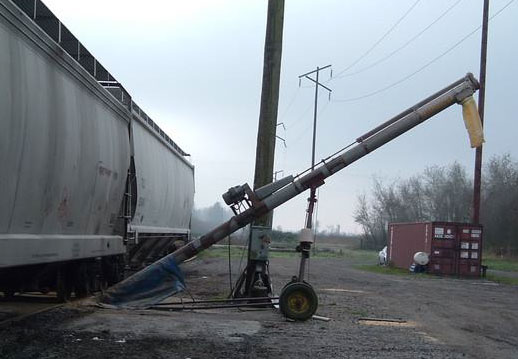
Maybe I'm answering my own questions with this posting, but do any of you have any thoughts or ideas on alternative industries and a new destination for my covered hoppers? Just remember that these type covered hoppers are only suitable for handling agricultural or similar type commodities. Commodities such as flour, sugar, plastic pellets, powdered chemicals, sand; are not suitable for these cars.
So many interesting ideas coming out of this thread , I thought I'd see what you fellows might come up with on this. Maybe it should have been a separate thread in the Industries Along The Rails section, but for now we'll leave it here.
By "space eating" I mean industries that require track lengths that are double the car capacity of the facility; grain elevators; coal tipples and similar industries that must move their cars to load/unload them, for example. Although I knew this when I found the industry; Trinidad Benham is a "space eater". If my model of this facility is designed to spot 3 covered hoppers, then the track must clear at minimum 5 car lengths (one in the shed unloading - and room for two more on either side) - not very efficient for an ISL. I really like this facility - it's large - not something you see every day and fits in to the modern industrial theme. But is it a good choice for an ISL?
The Temple-Inland industry is what I call an "operational" industry, meaning that several cars can spot on the industry track at specific locations and none of them must be moved for loading/unloading. I love large facilities that actually look like they would be rail served, but not if the number of cars that spot does not use most or all of the track space. IMHO, that's almost as bad as having a single car spotted at a structure that's only slightly larger than the car or a large structure that only has one car spot (they do exist).
So at this point, I'm wondering if I should replace Trinidad Benham with another "operational" type industry that would spot box cars (I love box cars!) or leave well enough alone? BUT if I do replace it with something, then what to do with my rather large fleet of trough hatch/gravity discharge covered hoppers?
I've seen many examples over the years of facilities where these gravity discharge type covered hoppers are spotted and don't require the cars to be moved because the shipper/consignee uses portable conveyors that can be moved as required. Jack Hill has one such example on his web site: http://oscalewcor.blogspot.com/2010/09/s...-spur.html.
I don't want to turn my plan (or any plan I conceive) in to a "track in every corner" type layout, but I could perhaps add another short spur to the plan where I could spot 2 or 3 covered hoppers without having to use excess track space. Question is what sort of facility would be on this spur?
I suppose if worse comes to worse I could simply spot them on the trans-load (team track) and use portable conveyors to load/unload some commodity. And while I'm thinking about it, does any one make HO scale portable conveyors like what is shown in this photo or would this be a potential scratch building project?
Maybe I'm answering my own questions with this posting, but do any of you have any thoughts or ideas on alternative industries and a new destination for my covered hoppers? Just remember that these type covered hoppers are only suitable for handling agricultural or similar type commodities. Commodities such as flour, sugar, plastic pellets, powdered chemicals, sand; are not suitable for these cars.
So many interesting ideas coming out of this thread
, I thought I'd see what you fellows might come up with on this. Maybe it should have been a separate thread in the Industries Along The Rails section, but for now we'll leave it here.
Ed
"Friends don't let friends build Timesavers"
"Friends don't let friends build Timesavers"